
Autonomy plus control isn't a compromise. It's the answer to AI anxiety. Every technology humans have ever trusted with something that mattered got trusted because a control layer was built alongside it.
Autonomy plus control isn't a compromise. It's the answer to AI anxiety.
I started this publication because I noticed something odd. Almost every argument about AI is really an argument about control.
I'll be honest about the rest of it too. It was curiosity first and foremost. But it was also anxiety. Not mine specifically, though some of it is mine too. The anxiety I mean is the one sitting under most conversations about AI right now, even the casual ones. It shows up as a joke at dinner about the AI that went ahead and did something nobody actually told it to do. It shows up as a headline about an AI agent trading stocks on its own. It shows up, more quietly, as something that's already happened and could happen again. In 2022, a grieving customer asked Air Canada's chatbot about a bereavement fare, and the bot invented a discount policy that didn't exist and told him to book first and claim it after. He did. The airline refused to honor it, a tribunal disagreed, and Air Canada had to pay anyway, because nobody had drawn a boundary around what the bot was allowed to promise on the company's behalf. That's the anxiety in miniature. Not "the robot is evil." Just, nobody was minding what it was allowed to say.
I think that fear is reasonable. I also think it's aimed at the wrong target. The scary version of the future isn't "AI becomes capable." Capability was always coming, and mostly it's good news. The scary version is capability arriving with nothing built to hold it accountable. Those are two different problems, and I've noticed almost every conversation about AI collapses them into one, which is exactly what keeps the anxiety so unspecific and so hard to put down.
So here's the thing I actually believe, and it's the reason this site exists. The anxiety has an answer, and it isn't slowing AI down or hoping it stays polite. It's control systems. Every technology humans have ever trusted with something that mattered got trusted because something else was built alongside it to keep it in check. A car earns your trust because it has brakes, not because the engine promises to behave. A surgeon operates within licensing boards, protocols and a hospital's chain of authority, not on vibes. Nuclear power runs inside some of the most exhaustively engineered control systems ever built by anyone, anywhere. None of these technologies became safe by being weaker. They became safe by design, not by accident, and someone had to engineer that deliberately.
That's the pattern I want this whole publication to sit inside. Not "is AI dangerous," but "does this particular system have a real control layer, and is it any good." That question is answerable. It's specific. And once you start asking it instead of the vaguer one, the anxiety starts to feel less like dread and more like a checklist.
Has "full autonomy" ever actually existed?
For as long as I can remember, "full autonomy" has been sold as the ultimate destination. The self-driving car that needs no driver. The warehouse that runs itself overnight. Now it's the AI agent that handles your inbox, your calendar, your customer support queue, your trades, without you in the room.
It's a compelling story, and I understand why it sells. It's clean. It has an ending. "The machine finally does it all" is a much better headline than "the machine does most of it, and a person handles the rest."
But I've never actually seen it happen, not in a way that stuck. What I've seen instead is capability creeping outward while the boundary around it gets redrawn, over and over, usually by someone quietly deciding how far the leash should go. The self-driving car still needs mapped roads and a remote operator on call. The warehouse robot still needs a person to handle the exception it wasn't trained for. The AI agent still needs someone to notice when it's confidently wrong.
None of that is a failure of the technology. It's just what deploying real systems into a world full of consequences actually looks like. If anything, I'd say the presence of a control layer is the tell that a technology has graduated from prototype to production system. The demo doesn't need one. The real thing always does.
So what does a control layer actually do?
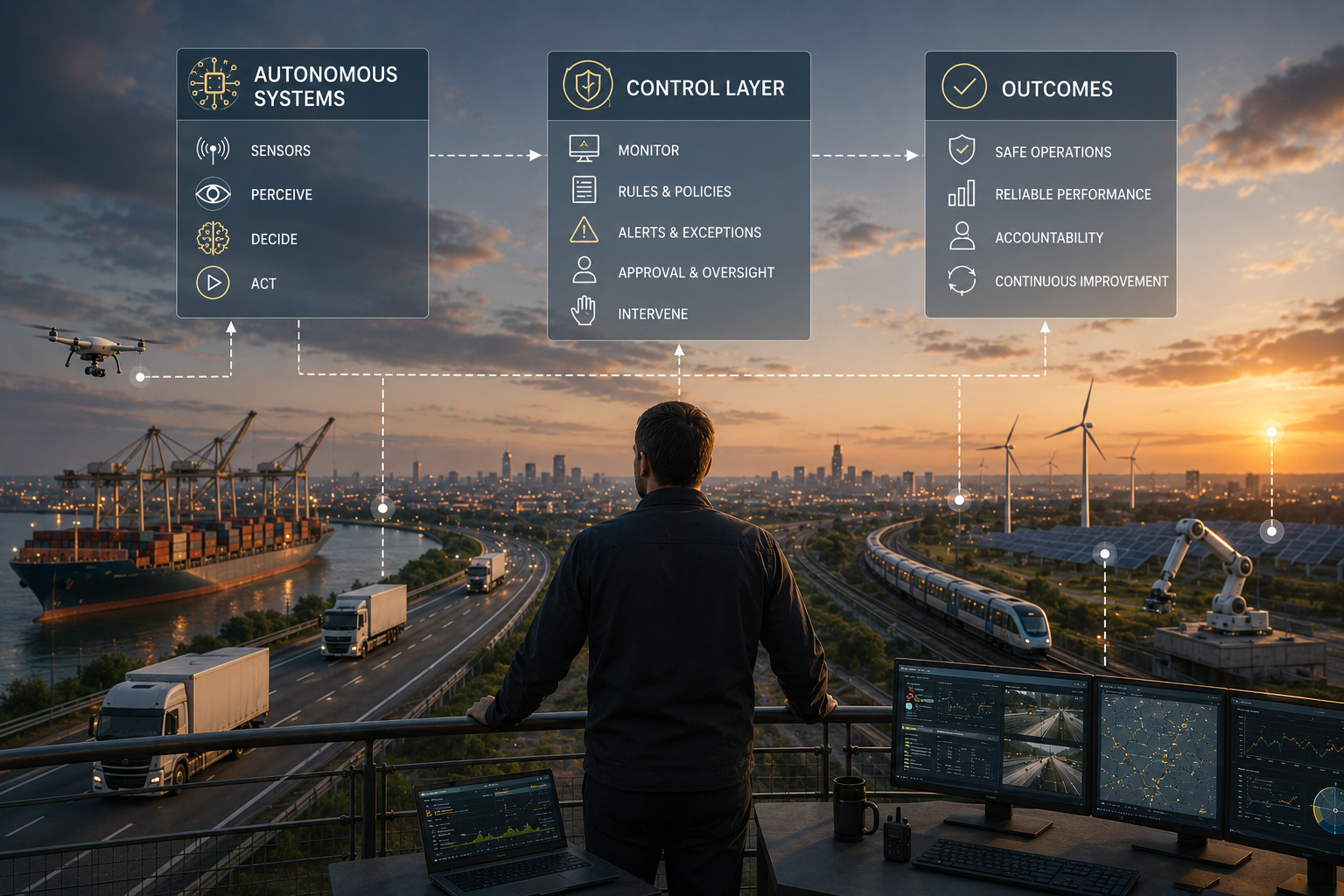
Here's the idea I keep coming back to, and the one this whole publication is built around. A control layer isn't a constraint bolted onto an autonomous system after the fact. It's a design requirement, the thing that makes an autonomous system deployable at all.
A control layer can take a lot of forms. Sometimes it's a person - someone who reviews the exception, signs off on the unusual case, has the authority to stop the process. This is the practice people usually mean by "human in the loop," and it's still the most common control layer there is, for good reason: a person can catch the failure mode nobody thought to design for. Sometimes it's another system entirely - a rules engine that won't let an action through past a certain threshold, a monitoring layer that watches an AI agent the way a supervisor watches a new hire, a circuit breaker that trips before things cascade. Sometimes it's simpler than that - a geofence, a hard-coded limit, a permission that was never granted in the first place.
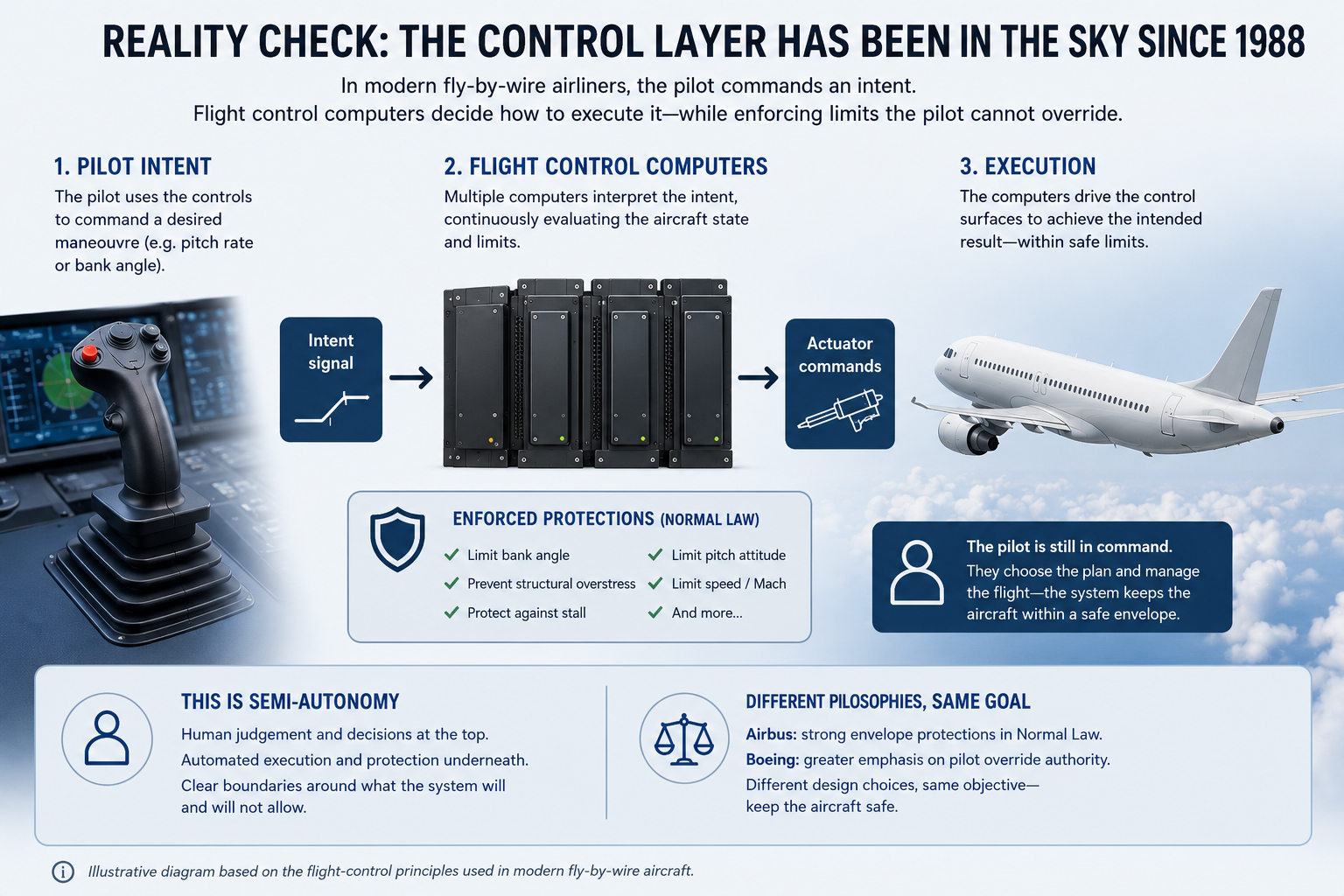
Reality check: the Airbus A320 has been doing this since 1988
Semi-autonomy isn't a new idea, and it doesn't need a humanoid robot or an AI agent making business decisions to count. A useful real-world example has been flying passengers around the world for decades. When Airbus introduced the A320 in 1988, it became the first commercial passenger aircraft with full digital fly-by-wire controls. In its normal operating mode, the pilot doesn't directly move the aircraft's control surfaces through mechanical cables. Instead, the pilot uses the sidestick to express an intended maneuver, and the flight control computers decide how to execute it, continuously accounting for the aircraft's speed, attitude, configuration and operating limits. The pilot still flies the aircraft, but the system sits as a control layer between human intent and physical execution.
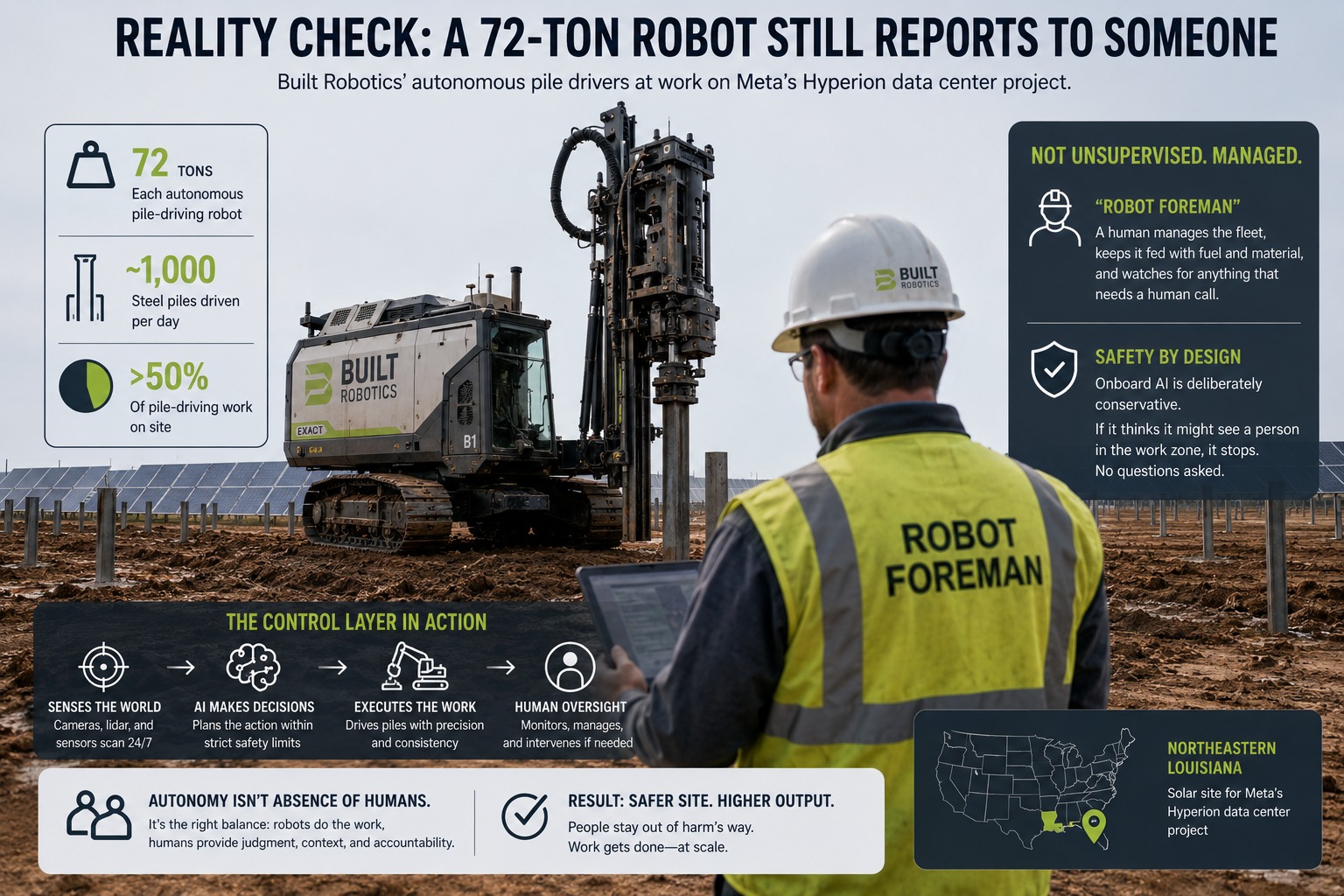
Reality check: a 72-ton robot still reports to someone
In northeastern Louisiana, Built Robotics has around ten 72-ton autonomous machines driving nearly 1,000 steel piles a day at a solar site tied to Meta's Hyperion data center project. The robots handle more than half the pile-driving on site. But they don't run unsupervised. Built's CEO, Noah Ready-Campbell, describes the human role as a "robot foreman" - someone managing the fleet, keeping it fed with fuel and material, watching for anything that needs a human call. The onboard AI is also tuned deliberately conservative. If it thinks it might be seeing a person in the work zone, it stops the machine, no questions asked.
Reality check: even central banks are questioning "human in the loop"
On June 30, 2026, at the European Central Bank's Sintra Forum, Bank of England Deputy Governor Sarah Breeden said something worth sitting with. She noted that more than half of finance firms are already running agentic AI in some form, and warned that existing regulatory frameworks simply weren't built for systems that can chain decisions together on their own. But her proposed fix wasn't "keep a human reviewing every single action." She said outright that relying on human in the loop for every agent action "is unlikely to be realistic." Instead, she pointed to market-wide circuit breakers and kill switches.
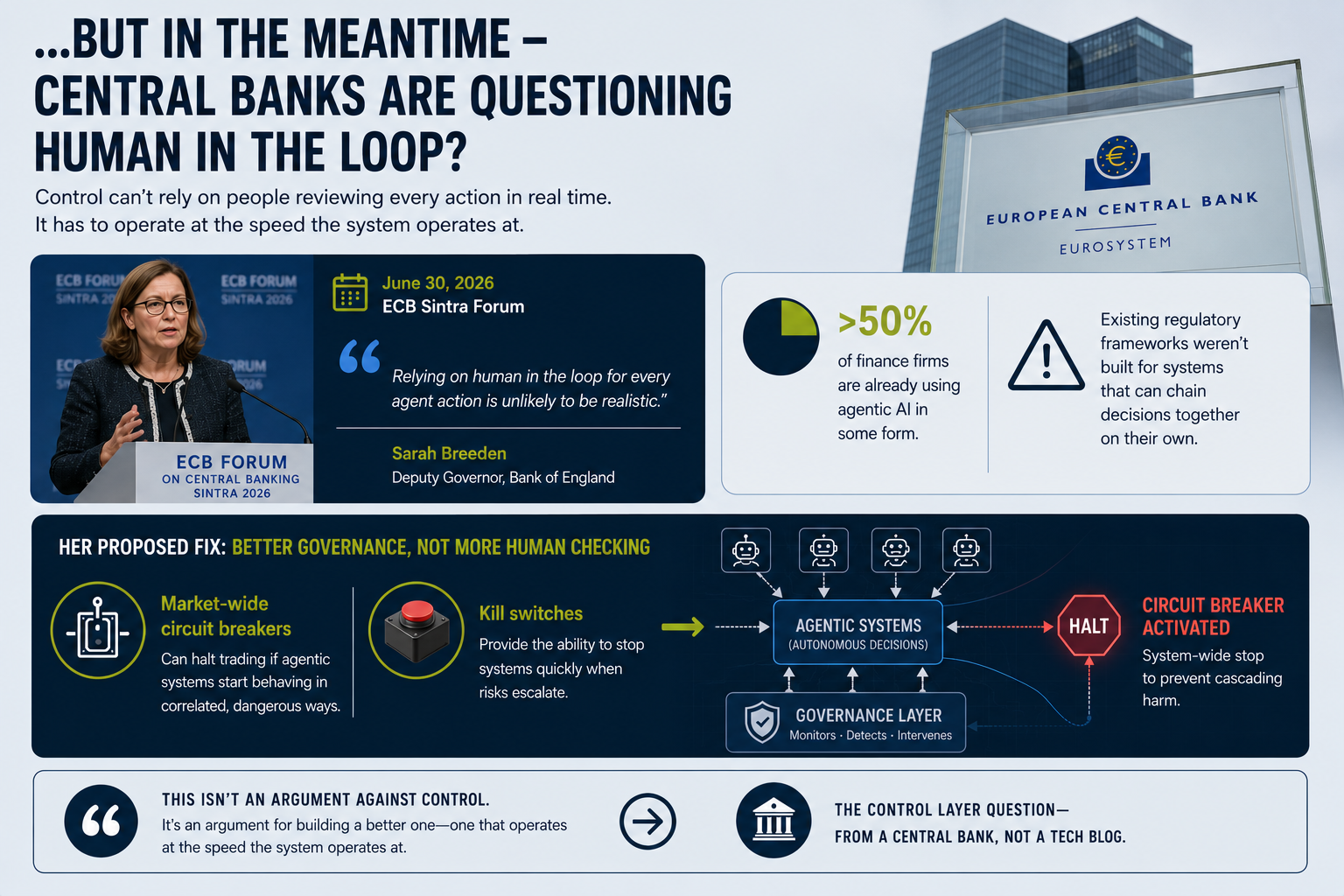
Read that carefully and it's not an argument against control. It's an argument for building a better one - one that operates at the speed the system operates at, instead of pretending a person can review everything in real time.
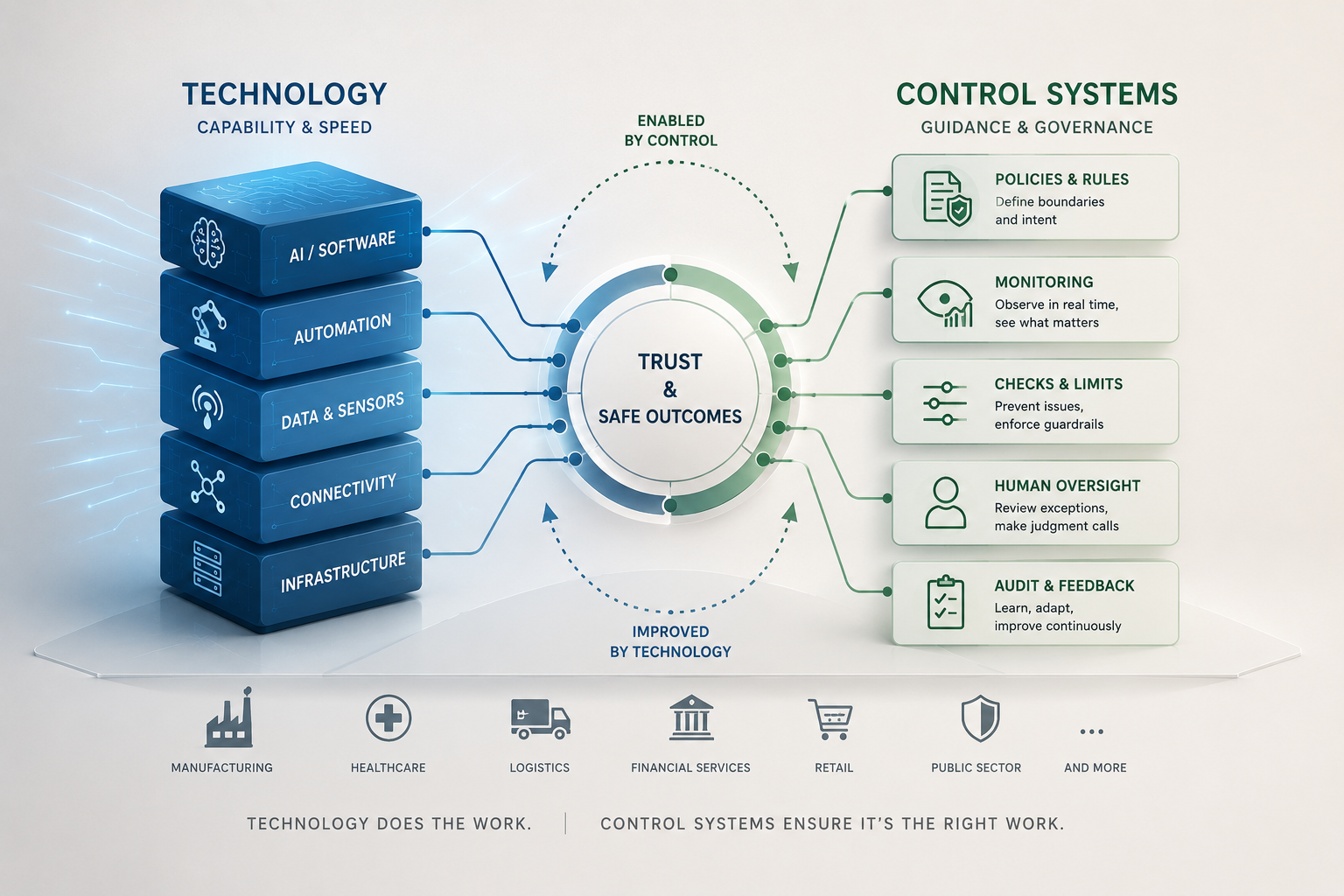
The systems that will earn a lasting place in how we work and live won't be the ones that eliminate the control layer. They'll be the ones that engineer it well. Clear boundaries, fast escalation, real accountability, nothing rubber stamped. Semi-autonomous isn't a hedge or a halfway point at all. It's the actual destination.