
Australia's Medicare fraud model flagged 597 potential matters and 82 were recorded as reviewed. Its replacement came with a volume dial.
In December 2025 Australia's Department of Health, Disability and Ageing stopped using an AI model that picked out potential fraud and non-compliance by health providers billing Medicare. It replaced the model with a logistic regression for a reason that had little to do with accuracy. The new model came with a threshold, and the threshold let the department decide directly how many selections went to manual assessment. The old one had been producing more than staff could process.
The Australian National Audit Office tells the story in a performance audit published in September. I mentioned the switch in Auditors found AI assessments missing at two tax agencies as a decision taken without a documented reason, though the audit's own figures say a good deal about why.
It helps to be exact about what the model was allowed to do, because the headline figures blur it. The model generated signals that became potential matters, with one provider able to produce several. Officials then reviewed those matters. Some went on to preliminary analysis, those where concerns persisted were referred, and only after further assessment or investigation did anything reach treatment, which is the department's response to a provider. The model decided none of that. Its authority ended at choosing what people would look at, which sounds modest until you notice that choosing what people look at also decides what they never reach.
The model has been reported as 22% accurate, and Table 5.1 of the audit gives the arithmetic behind that figure. The table's analysis window runs from August 2023 to August 2025, though the AI model only entered use in July 2024. Within that window it identified 597 potential matters. Eighty-two of them were reviewed, a review rate the table rounds to 14%. Of those 82, eighteen were classed as true positives and 64 as false positives, which is where the 22% comes from. A note to the table says the true positives include eight potential cases referred for preliminary analysis. The audit does not otherwise define the category, so eighteen true positives should not be read as eighteen frauds.
So the 22% describes eighty-two matters and says nothing direct about the other 515, which were not recorded as reviewed in this analysis. I found nothing in the audit saying they were examined some other way. If the matters picked for review were the ones that looked strongest, the figure flatters the model. If they were picked for some other reason, it could understate it. Either way it belongs to a subset whose selection is not described, and that is a poor base for any verdict on accuracy.
The same table lists the department's other models at 10%, 87%, 6%, 46%, 50% and 47%, and a note warns that they look for different behaviours and are unsuitable for direct comparison. I take the warning seriously. Those other rates cannot establish that the AI model performed badly, though it could still be judged against an operational target suited to what it was looking for, and the audit reports no such target. What the audit does establish about the AI model is the thing the department acted on, that it produced work faster than people could take it.
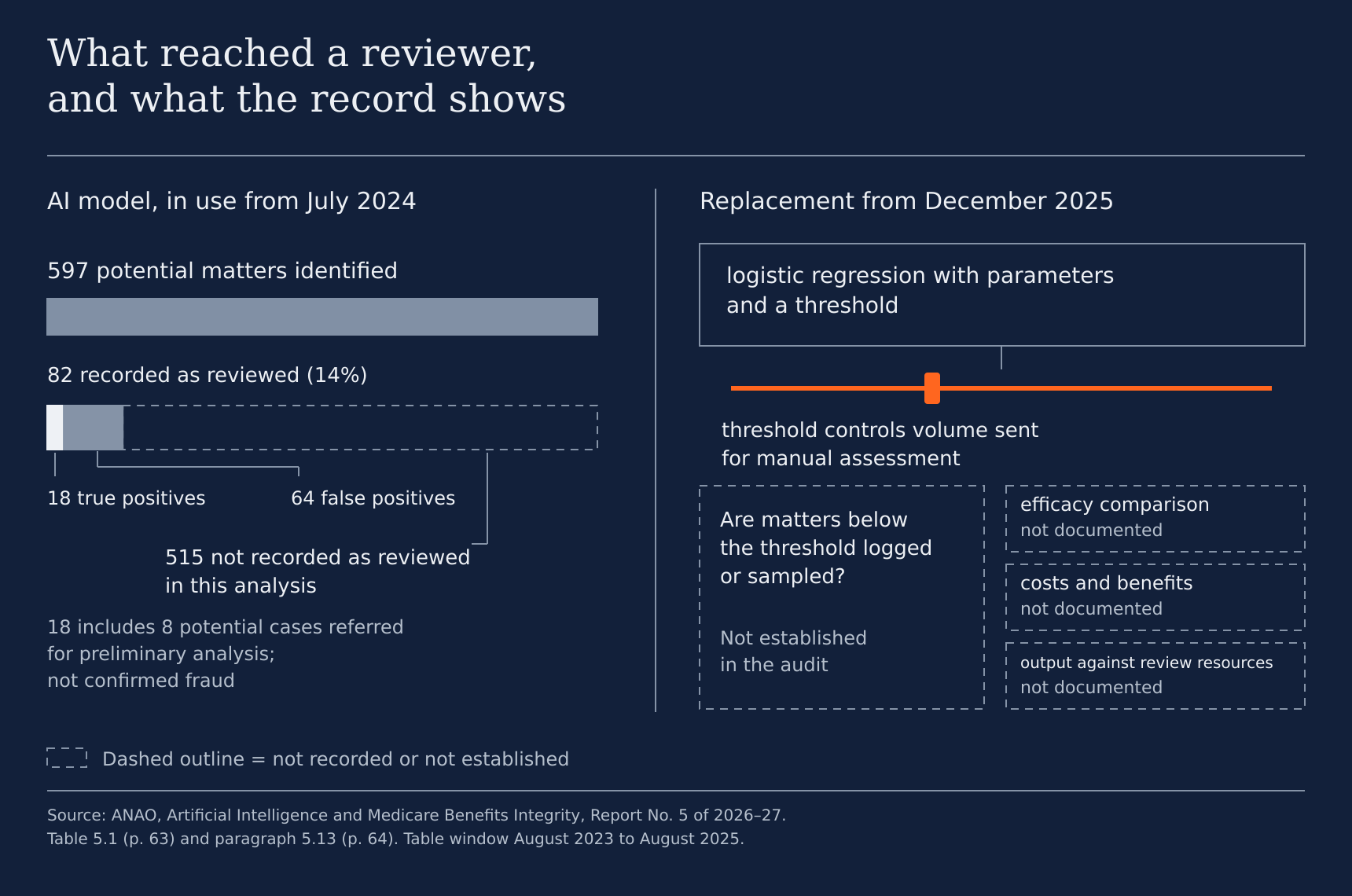
That makes the replacement interesting for what the department chose to value. Paragraph 5.13 records that the new model offered parameters and a threshold giving direct control over how many selections went for manual assessment. That is a capacity control. It treats the reviewers as the scarce resource and fits the referrals to them, and I rarely see that instinct written down in an official record.
Paragraph 5.13 also records what was missing. The department did not document a comparison of how the two models performed, or an assessment of costs and benefits. More oddly, it did not assess the AI model's output against the review resources available, though that mismatch was its own reason for switching. It recognised the constraint and acted on it without measuring the constraint or the effect of the remedy. The replacement is a documented change of control, and nothing in the audit shows it worked.
Nor do the passages I have read say who may change the threshold or on what basis. Paragraph 5.13 attributes the decision to the department as a whole. That leaves the question I would ask first about any boundary, who is allowed to move it, without an answer in the record.
Monzo, the British bank, describes a different allocation of the same kind of work. In a post on 27 July 2026, two of its engineers explain how it handles authorised fraud, where a customer is persuaded to send money to a fraudster themselves. When a payment looks risky the customer is asked questions, and a multimodal language model turns the answers and any supporting evidence into structured signals. Monzo says the whole process takes under ten seconds. The post says plainly that the language model is never asked to decide whether a payment is fraudulent. Supervised models combine those signals into a fraud probability, and human investigators take the higher-risk cases.
Monzo reports that the design raised both the number and the value of authorised fraud cases it prevents by over 20%, while fewer legitimate payments are diverted to its human review teams. The second half of that sentence is a claim about the reviewers' workload. It comes from the organisation that built the system, with no baseline period, sample size or error rate published, and it cannot be set against the Australian figures as a controlled comparison. What it adds is a design whose builders report the volume reaching people as an outcome alongside fraud prevented, where the Australian department recorded that volume as its reason for stopping.
When the checkpoint stops carrying information asked whether a reviewer catches what is in front of them. This case asks the earlier question of whether anything gets in front of them at all. A person placed after a model supervises the share of its output they can reach. What happens to the rest, whether it waits, lapses or is handled some other way, is a separate question that the record has to answer.
My own view is that the department's fix was intended to make review feasible, and it leaves a different question open. Under the AI model, 515 potential matters were not recorded as reviewed, and at least that number was visible in the analysis. A threshold decides in advance which matters never reach a person through this referral route, though some may surface another way. Whether the replacement keeps a record of what it excludes, and whether anyone samples those exclusions, is something the audit does not establish either way. Until someone checks, a manageable queue would show at most that the reviewers can keep up, and nothing about what they were never given.
I would like to see review capacity reported the way an operations team reports any queue, with arrivals, completed assessments, waiting time and unresolved work, published next to the model's hit rate. Those four numbers show whether reviewers keep up. They cannot show what the process misses, which takes a periodic look at a sample of the excluded cases. An organisation that has neither knows where its reviewers sit and not what they cover.
Sources
- Australian National Audit Office, Artificial Intelligence and Medicare Benefits Integrity, Auditor-General Report No. 5 of 2026–27, September 2026. Paragraph 1.27 and Figure 1.4 (pp. 24–25) for the process from signal to treatment; paragraph 5.11 (p. 62) and Table 5.1 with its notes (p. 63) for the review and true-positive figures and the comparability caveat; paragraph 5.13 (p. 64) for the discontinuation in December 2025, the threshold-based replacement and the comparisons not documented
- Tom Turner and Robin Dhamankar, Combining generative AI and predictive modelling to fight financial crime, Monzo blog, 27 July 2026
The Australian figures come from an independent statutory audit. Table 5.1 covers an analysis window of August 2023 to August 2025, and the AI model entered use in July 2024. The audit's true-positive category includes eight potential matters referred for preliminary analysis and is not otherwise defined, so it should not be read as confirmed fraud. The 515 matters described here as unreviewed are those not recorded as reviewed in the audit's analysis. The audit records that the replacement model was adopted without a documented comparison of efficacy, costs and benefits, or output against review resources, so its effect is unknown, as is whether excluded matters are logged or sampled. The Monzo account is the organisation describing its own system, with no baseline period, sample size or error rate published, and it is used to illustrate a design rather than to measure one. The prose was drafted with AI assistance. The research, verification and editorial decisions are the author's.